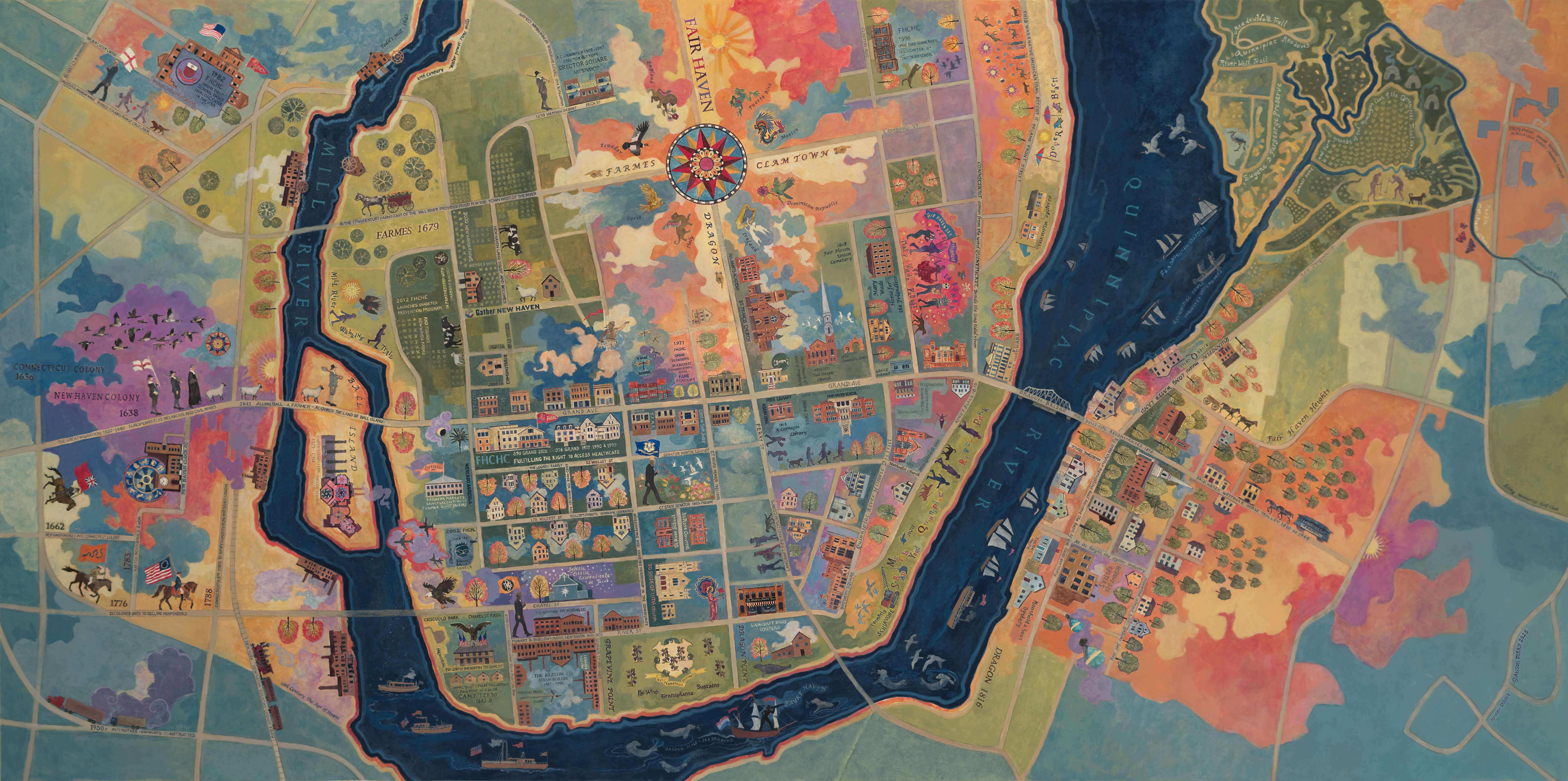
Common Ground
Acrylic polymer, pigment, and ink on Evolon microfiber, 48 x 96 inches - Alison Berry © 2026
A project commissioned by Fair Haven Community Health Center, New Haven, CT.
About the project:
This painting was commissioned in 2024 by the Fair Haven Community Health Center. The FHCHC first opened to patients within a school on Grand Ave in 1971, gradually adding a network of clinics in buildings throughout the community. Installed in the first new building erected on their campus, this commission honors the contribution of Senator Martin and Mrs. Ellen Looney to the FHCHC. The Looney family lived nearby on Woolsey and Wolcott Streets for many years, and continues to work for the health and vitality of the community.
The painting presents a pictorial map of Fair Haven through time, beginning thousands of years ago when tribal peoples summered on Grannis island, farming, and gathering shellfish from the Quinnipiac River.
European immigrants arrived in Fair Haven the early 17th century, fleeing civil and religious wars. Neighborhoods of distinct economic character soon developed. The west side, near the Mill River, consisted mainly of farms and mills which produced food for the growing city of New Haven, and was called "Farmes". The east side, on the Quinnipiac River, was known for an abundance of clams and oysters, and duly dubbed "Clamtown". To the south, where the Quinnipiac joins Long Island Sound, mariners found a particularly good harbor. They navigated to it by listening for the barking of harbor seals, which they called dragons, and so named the area "Dragon".
In the eighteenth and nineteenth centuries, maritime trade and the oyster industry were mainstays of the economy near the Quinnipiac River. At its height, the Fair Haven oyster industry produced about five thousand gallons per day, and wealthy sea captains built mansions and endowed churches.
By the late nineteenth century, railroads and steam powered ships were connecting cities and markets around the country. The end of the Civil War brought a boom in industrial activity, and the preeminence of Fair Haven companies such as Bigelow Co. Steam Boilers. The old water driven mills along the Mill River converted to steam power and factories expanded.
Fair Haven continues to evolve as immigrants arrive from many places, some as dreamers and some as refugees. They share common hopes for a better life, the love of family and friends, good health, and prosperity. They plant gardens, teach their children, work, make music, prepare and share food, as people have done in this place for thousands of years. Nourished by the rivers that border it and by the diverse peoples and cultures that have shaped it, this remains common ground.
– Alison Berry