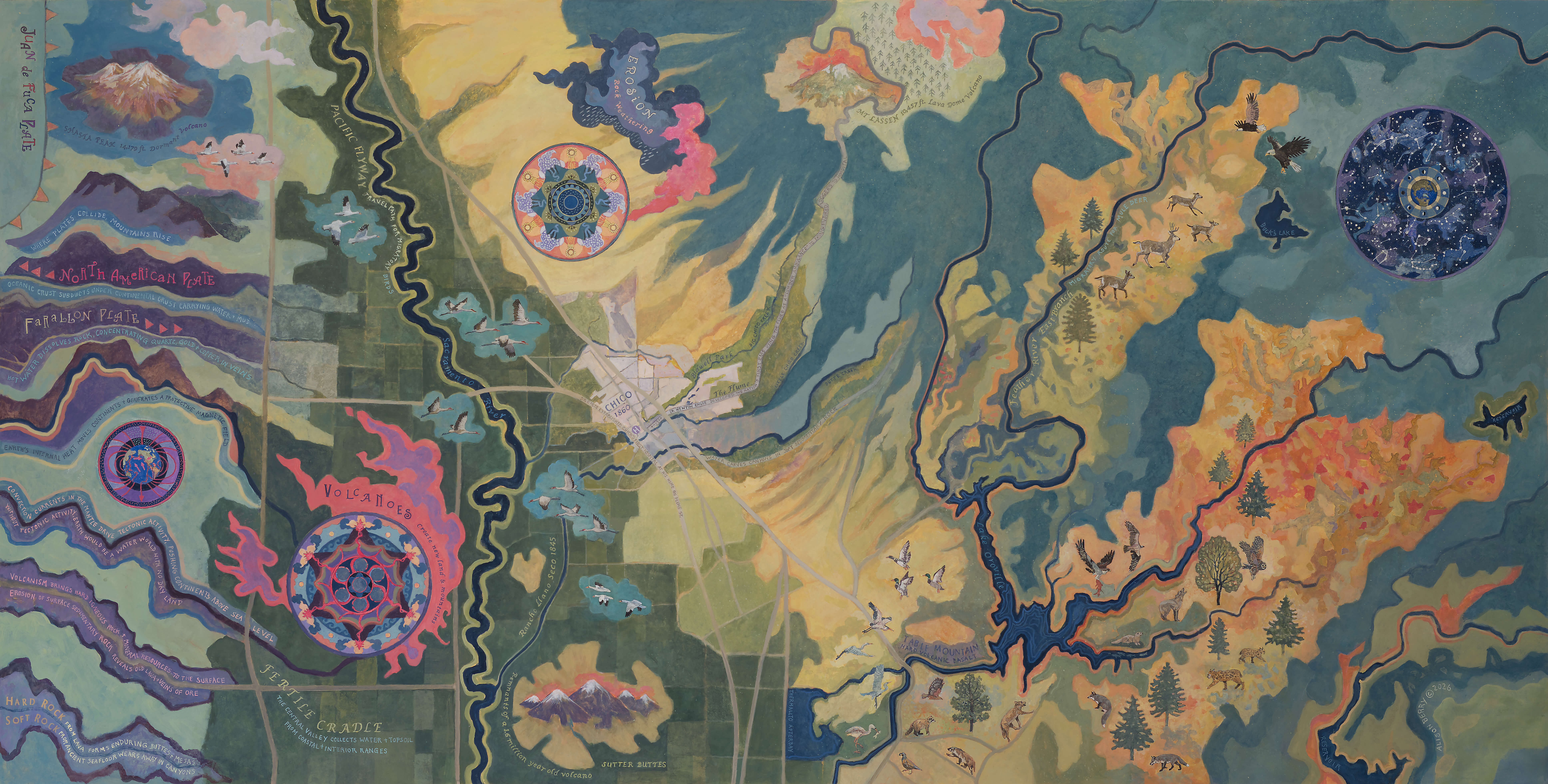
Terra Firma
Acrylic polymer, pigment, and ink on Evolon microfiber, 40 x 80 inches - Alison Berry © 2026
A project commissioned by Enloe Health, Gonzales Comprehensive Cancer Center, Chico CA.
About the project:
The volcanic peaks and canyons near Chico, California, present a landscape of dramatic beauty. They also reveal a 200-million-year geologic odyssey, which has shaped the American west.
The image of our planet from space is iconic - a "pale blue globe" with familiar oceans, continents, and clouds. But it only shows a fleeting moment in time. Earth's geologic contours are constantly changing, reshaped by intense internal heat and pressure. Without these forces to break the crust into plates and push land above sea level, our planet would be a "water world", devoid of terrestrial ecology.
California's geologic drama began as the supercontinent Pangea broke up, and the North American Plate moved west, colliding with the oceanic Farallon Plate. Through "flat-slab subduction," the Farallon Plate slid horizontally beneath the continent, dragging seawater and minerals into the hot depths. As the plates moved slowly but inexorably over millions of years, this process ignited volcanoes and pushed up mountains, shaping the landscape as far east as the Rocky Mountains.
The Sutter Buttes are an enigmatic monument to this ancient subduction. Standing alone in the valley, they were formed about 1.6-million years ago by exceptionally thick volcanic magma, which pushed through a weak spot in the valley’s crust and piled up to form mountains. To the east, formations like Table Mountain reveal ancient basalt lava that flowed and pooled in depressions, appearing only after millions of years of erosion wore away the softer surrounding rock. Near Lake Oroville, subterranean interactions created the "mother lode," as superheated water dissolved minerals and concentrated veins of ore.
While this geologic story took millions of years to unfold, biology was busy on our living planet. Volcanic eruptions and earthquakes can be destructive events, but they also play a positive role in earth’s ecology, bringing resources from the mantle to the surface biosphere. Carbon dioxide, belched in gaseous form, is an essential ingredient for photosynthesis, along with water and sunlight. Volcanoes contribute potassium, phosphorus, calcium, and magnesium, enriching agricultural soil. California’s Central Valley, cradled between coastal and inland mountain ranges, contains some of the world's most fertile land because it collects these resources along with water and topsoil.
Competing with dense human populations and industrialized agriculture, animals find sustenance where they can. Big Chico Creek is spring fed and provides a cool sanctuary in summer for Chinook salmon and steelhead trout. Migratory birds such as snow geese and sandhill cranes pause for rest and snacks in agricultural fields along the "Pacific Flyway". The Lake Oroville Wildlife Area hosts mammals including coyotes, foxes, bobcats, and river otters, along with aquatic birds, eagles, and ospreys. Following the Feather River, herds of Mule Deer migrate between summer and winter ranges.
Viewing the starry night sky from my perch on terra firma, I am inspired to consider how the forces that shape our planet also shape our universe, and to contemplate nature's vast mystery.
– Alison Berry, 2026